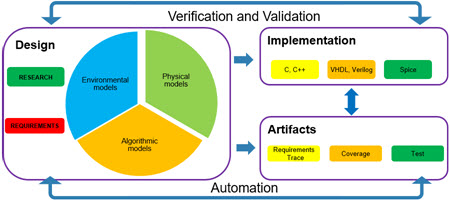
Adoption Time Line: Exploration Phase Part I

In our last post we reviewed the high level adoption time line; in this post, we will cover the exploration phase.  The objectives of the exploration phase are to

  • Understand the factors that influence the time required for adoption
    and
  • Set deliverable for the initial adoption phase.  (covered in part II)

From the last post, the factors influencing the adoption timeline are

  • Current usage of modeling tools:  The level of current knowledge and usage of modeling tools will influence the initial training and evaluation required.
  • Current software development processes:  The software processes adopted as part of a Model-Based Design workflow will leverage or extend many of your current software development processes.  The more formalized the existing processes the simpler the transition.
  • Compliance with high integrity software development processes: For a subset of software development projects compliance with high integrity processes such as the DO178-C or ISO 262622 imposes verification and traceability requirements that other processes can omit.
  • Processes required for development:  The Model-Based Design environment offers multiple tools for the development of software.  Determination of which tools and processes are required is done as part of the initial adoption phase.

The first step in exploration phase is to identify the stakeholders in the change process. and to understand the current development process both what works well and what needs improvement.  threeps


Role Deliverable
Controls Engineer Outlines current controls development workflow and roadblocks.
Software Engineer Outlines current software development process and method of integrating with the controls software
Project manager Outline current Key Performance Indicators (KPI)

Questions you should ask

  1. How do you currently connect requirements to
    1. Controls deliverable
    2. Testing
    3. Bug tracking
  2. What is your controls development process, waterfall, scrum,  design V?
  3. What are your current software tools
    1. Version control
    2. Bug tracking
    3. Test infrastructure
    4. Requirement tracking
  4. How is the software handed off between
    1. Controls and software engineers
    2. Controls and  test engineers
  5. What is your current testing process
  6. Where have most bugs entered into your current development process?

In the next post

In the next post, I will outline what questions you should ask moving forward.

Model-Based Design Adoption Time Line

This post starts a section looking at the timing and requirements of each phase of establishing a Model-Based Design culture.   With that in mind, the timeline for adopting an MBD process and establishing an MBD culture is dependent on multiple factors including, but not limited to

  • Current usage of modeling tools:  The level of current knowledge and usage of modeling tools will influence the initial training and evaluation required.
  • Current software development processes:  The software processes adopted as part of a Model-Based Design workflow will leverage or extend many of your current software development processes.  The more formalized the existing processes the simpler the transition.
  • Compliance with high integrity software development processes: For a subset of software development projects compliance with high integrity processes such as the DO178-C or ISO 262622 imposes verification and traceability requirements that other processes can omit.
  • Processes required for development:  The Model-Based Design environment offers multiple tools for the development of software.  Determination of which tools and processes are required is done as part of the initial adoption phase.

There are 5 phases of adoption and a 6 ongoing optimization phase.  The adoption and establishment can take between 3 to 5 years depending on scope as outlined above

  1. Exploration phase: 1 ~ 3 month
  2. Initial adoption: 3 ~ 6 months
  3. Validation project: 6 ~ 9 months
  4. Group roll out: 12 ~ 18 months
  5. Department roll out: 15 ~ 24 months
  6. Optimization: ….

In future posts, we will look at these phases in detail.

Model-Based Design: Preventing Factors


The decision to adopt a new process can be viewed from two directions, what drives and what prevents companies from embracing new methodologies. In last weeks post we looked at the driving factors, this week we will talk about the preventive factors.

Core preventive factors

The motivation behind preventive factors are easy to understand; staying with the status quo is free of immediate risk.  At first glance it facilitates project planning based on known development costs.  However time and labor estimates are only accurate in situations of incremental change, such going from version 10.3 to version 10.4 of a stand-alone electronic throttle controller (a 20+ year old technology, with minor software updates) However that is rarely the case.  The growing complexity of software systems exacerbates the problem of time and labor estimates.

Additional preventive factors

The previous product development risk is the factor most often given by managers; on the other hand, the technical staff (controls and systems engineers) consider the following issues.

  • Loss of code efficiency
  • Lack of ability to customize
  • Concern about interfacing with existing code
  • Need to train on new tools
  • Not accepted for safety critical workflows


How Model-Based Design addresses these factors

In my previous post, Model-Base Design Driving Factors, the issues around increasing complexity, decreasing cycle time and the drive for cost reduction.  In today’s post we will look at the engineers’ concern.  First the loss of code efficiency.

Code efficiency: Code efficiency referees to the memory usage (RAM / ROM) and the execution speed (FLOPS) required to execute a given algorithm.  Currently, automatic code generators do not produce code for single functions that is equal to the best C/C++ programmers.  However, they produce better code than the average C/C++ programmer(1) and, for large systems, can find optimizations that humans may overlook.  Further, any time a controls engineer spends becoming a better C programmer is time they are not spending becoming a better controls engineer.

In future sections of this blog, we will examine which areas are best developed using automated code generation tools and which should be done using hand coded methodologies.

Lack of ability to customize: Modern code generation tools provide users with the ability to fully customize the

  • Function interface
  • Data scope / data type
  • Function partitioning
  • Execution rates
  • Code formatting

What is more, once the customization has been defined the tool will consistently follow the pattern, unlike human programmers who are can easily make formatting and functional mistakes.

Ability to interface with existing code: When transitioning to a model centered workflow there will be existing C code that will be used the difficulty in continuing to use these functions is dependent on 4 primary factors

  1. Is the function well partitioned?
  2. Is the function intended behavior well defined?
  3. Is the code well documented?
  4. Are there test cases for the function?

As you may have summarized the ability integrate existing code into a Model-Based Design workflow is similar to the ability to reuse functionality between projects.  With modern Model-Based Design, tools allow users to easily integrate code assuming that the code is well partitioned.

Training on new tools: From a strict interpretation this critique is valid, however, it assumes a workforce that is already fully trained on existing C-based design workflows.  As this link shows, C is no longer the most common starting programming language.  Further, unlike model centered designs, does not directly map onto the engineering notation used by controls engineers.  With this in mind understanding training can be viewed as a one-time additional cost.

Next week’s blog

In next week’s blog I will examine a typical timeline for adopting Model-Based Design addresses within a group and across your organization.

Establishing a Model-Based Design Process

Charles Dicken’s novel, “A Tale of Two Cities“, was originally published in a serialized format in 31 installments over 6 months. Now the book that the average 10th grade high school student reads is the refactored final product. In that spirit over the coming year, I will be writing a series of blog posts that I will later collect into a book format. As a preview here is the high level outline of the material.

  • Motivating factors: What drives people to adopt Model-Based Design and how that driving force affects the order of adoption
  • Pillars of Model-Based Design: What are the key elements that define a Model-Based Design workflow.
  • Laying the foundation: What are the first steps in establishing a culture of Model Dased Design.
  • Validating your processes: How do you assess the success and failures of your establishment process?
  • Expanding the scope of Model-Based Design activities: How and when do you ramp up on the methods used as part of the Model-Based Design workflow.
  • Deploying the process across your organization: A discussion on methods for deploying the process across your organization and how to collect feedback from the members of the group.

BIO

Michael Burke is a consultant with The MathWorks and former coordinator for the MathWorks Automotive Advisory Board (MAAB). I currently focus on Model-Based Design Process Adoption and Establishment projects. Views expressed in this article do not represent the views of The MathWorks.